The strip between Dresden and Prague is one of the most under-used event regions in Central Europe: châteaux, spa hotels and industrial halls an hour from either capital, at a fraction of the cost, with two countries’ guest lists inside a single day’s travel. This page maps the venues that actually work for corporate events on both sides of the border — and what photographing them costs.
Why companies hold events here
- Two capitals, one drive. Most of the region is inside 90 minutes of both Dresden and Prague, and inside three hours of Berlin. Guests from Saxony and Bohemia arrive on the same afternoon.
- Venue budgets. A château evening or a spa-hotel congress on the Czech side typically costs a fraction of the equivalent room in Berlin or Munich.
- Landscape. Saxon and Bohemian Switzerland give an incentive or team programme something no city venue can — and give the photographs a location that is instantly recognisable.
- Cross-border teams. German companies with Czech production, and Czech companies selling into Germany, meet where neither side has to travel further than the other.
The venue map
Děčín and the Elbe valley
Zámek Děčín and the river hotels: château halls, terraces over the Elbe and gardens for a summer reception. Warm stone, hard midday light, beautiful in the last hour.
Ústí nad Labem
The Větruše château above the city and the industrial conference space below it. A working city rather than a pretty one, and priced accordingly.
Bad Schandau and Pirna
Spa and hotel venues on the German side of the national park. Small congresses and management retreats; daylight rooms that change by stops across the day.
Liberec and Zittau
Babylon Liberec for larger congresses, plus the historic halls in Zittau. The northern route, an hour from both Dresden and Prague.
Teplice, Most and Chomutov
Spa halls and industrial-park conference centres. Where manufacturing customers actually hold their supplier days.
Karlovy Vary
Grandhotel Pupp and the Thermal congress complex — the region’s grand end, used for festivals, galas and international congresses.
The one thing that catches organisers out: a venue an hour outside a capital rarely has in-house AV, and often has house rules on additional lighting written for weddings rather than congresses. Both are solvable, and both need to be settled a week before the date rather than on the morning.
Town by town: 25 venue guides
Each guide covers the venues that actually take corporate events in that town, the house rules and permits to clear first, access times from Berlin, Dresden, Prague, Nuremberg or Munich, and what photographing the rooms involves.
Bohemia and the Czech side
- Ústí nad Labem
- Děčín
- Liberec
- Jablonec nad Nisou
- Teplice
- Most and Chomutov
- Litoměřice
- Karlovy Vary
- Mariánské Lázně
- Cheb and Františkovy Lázně
- Plzeň
- Bohemian Switzerland
Saxony, Bavaria and the German side
- Pirna and Bad Schandau
- Zittau
- Görlitz
- Bautzen
- Chemnitz
- The Erzgebirge
- Leipzig
- Hof and Selb
- Bayreuth
- Regensburg
- Nuremberg
- Passau
- The Upper Palatinate
Browse all event location guides ›
Photographing cross-border events
Practically, a border event is a logistics problem with a photographic one inside it.
- One photographer, both sides. A factory visit in Bohemia in the morning and a dinner in Saxony in the evening is one booking, not two. Travel between sites is billed at cost.
- Two languages on the day. Briefings, coordination with venue and AV staff, and image captions are handled in German or English.
- Two sets of house rules. Czech châteaux and German protected buildings both restrict tripods and additional lighting; permission is arranged before the date.
- Consent that works in both places. A photography notice in the invitation, signage at the entrance and a visible opt-out marker satisfies German and Czech practice alike.
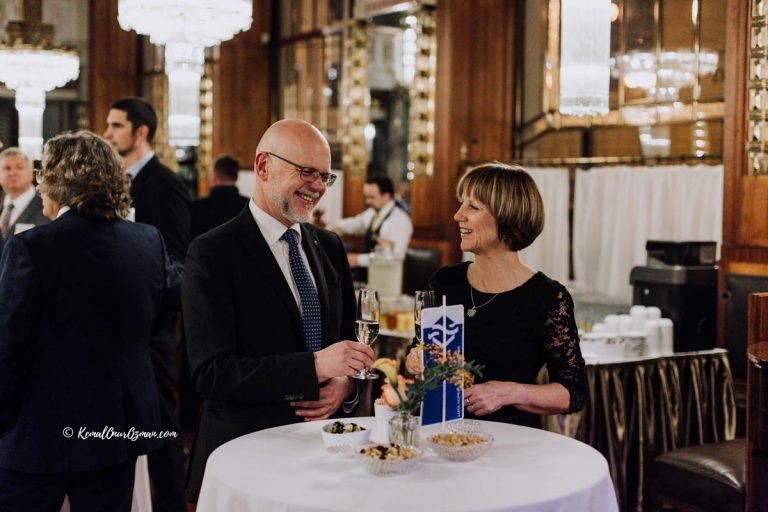
- Rooms that are genuinely dark. Château halls and spa ballrooms are lit for atmosphere, not for a camera. Fast glass and bounced fill; nothing is ever flashed across a dinner table.
Prices
The same fixed, all-in rate card applies across the region as in Berlin, Dresden and Munich. Travel is quoted at cost from Berlin, Dresden or Prague, whichever is nearest to your venue.
| Half day — up to 4 hours | from €950 |
|---|---|
| Full day — up to 8 hours | from €1,650 |
| Additional hour | €200 |
| Multi-day events | −15% from the second day |
| On-site headshot day | from €1,200 |
| Second photographer | from €790 per day |
All figures are net starting prices for a fixed, all-in quote and include the shoot, the edit, a private online gallery and usage for your own marketing, press, recruiting and internal channels. Any applicable VAT is shown on the invoice. Travel outside the city is billed at cost, never marked up.
What every quote includes
- A pre-event call about the run-of-show and what the pictures are for.
- Full coverage of the agreed window, shot against a shot list agreed beforehand.
- Professional editing — colour, exposure and a real cull, not an unfiltered card dump.
- A private online gallery with high-resolution downloads, sorted by session and subject.
- Usage for your marketing, press, recruiting and internal channels, with no per-image fees later.
- Backup bodies and dual-card recording, so a card failure is never your problem.
- Files archived for twelve months.
Getting a quote
Send the venue — the name alone is usually enough — the date and times including setup, the type of event, and what the photographs are for. Availability and a fixed price come back within 24 hours. If the programme runs on both sides of the border, say so; it changes the travel line, not the day rate.
Planning an event between Dresden and Prague?
Send the venue and the date. Availability and a fixed, all-in price come back within 24 hours, in German or English.